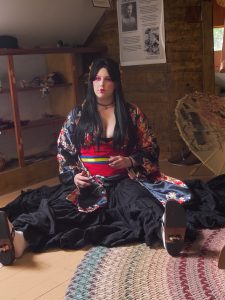
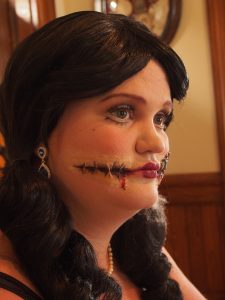
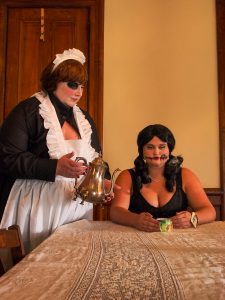
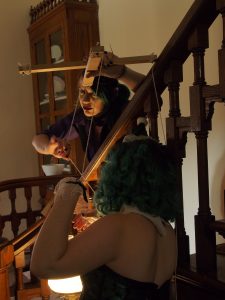
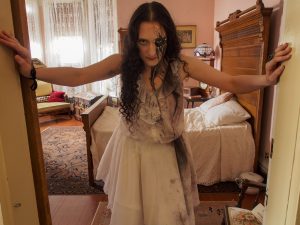
The last fortnight or so has seen some interesting sites and experiences. The wagon ride from Klausenburg to the remote farm in charge of my fields took nearly three full days. We accomplished about 75 kilometers during that time.

ZOMBIE thumb3 July 14th, 1878
Situated as it is on the edge of some small mountains, many of the locals have vigorously turned from farming to mining. Having a good source of Iron was important during the war for the manufacture of cannon and every source was exploited to it’s fullness.

With the need for iron and steel not so great, many of the young men here will go back to farming. The land requires little work to grow grains or corn. Livestock consists of mostly goats and swine which thrive well in this climate.

A day and a half after my arrival, Madam Ioana Munteanu was found dead in her barn. Her husband reported that she had seemed a bit stiff that morning but thought little about it at the time.

victorian post mortem photography 06 thumb July 14th, 1878With the customary three days of day and night vigil over the body, and the mourning meal where the whole village turns out, Madam Munteanu was put to rest and a simple stone erected to mark the location of her grave.

Having observed these customs first hand and partaken of a portion of sarmale myself, I decided to stay the night in the village and eagerly accepted the pastor’s invitation to a bed and intellectual conversation in his nearby cottage. This was carried out in that modernized Roman language, being one that we both had in common. My Slavic languages being weak, and his European ones being as bad.

Towards morning, soon after the cock began to crow, the caretaker came pounding and shouting upon the door. My host sprang to see what the poor man’s shouting was. Within a short time, he came back telling me in Latin, that the new grave had been desecrated.

With the purpose of a man about to enter battle, he donned his vestments and marched into the graveyard. I followed behind to lend a hand if possible and see the miscreantants brought to justice.

But to our horror we found the grave not only desecrated, but the body missing! The Pastor roused the caretaker to fetch some help among nearby citizens while the two of us examined the scene for more clues.

In a fit of reasoning from that school of thought recently popularized by Mr. Holmes himself, we found not one sign of a shovel or marks other then a single set of woman or child sized impressions leading away from the grave. The wooden box still laid at the bottom, it’s top broken crudely rather then removed. The culprits, if any, had not been kind to the poor woman.

Suppressing a fear for the worse, I failed to voice my knowledge of a similar event some years past. The Pastor would not have believed me anyways as we had plainly seen the poor woman dead only yesterday and with our own eyes. Nothing less then the whole village would be able to back him up.

Never less we repaired to the cottage again for a simple breakfast. I ventured to broach my fears with him over a piece of toast and some warm tea.

“Sir, do you read Latin?”

“I do indeed,” was my reply. He nodded at my assent, went to a book shelf and brought back a worn leather tome. Turning the thin parchment to a point halfway in, he showed me a diary entry dated about February 18, 1523. The common Gregorian Calendar not being in use at the time, I had to mentally figure the date.

What I found astounded me. Eradica mortuus pedites, or the walking corpse. The details of the entry matched perfectly the news I had heard while in Africa. The simple pastor looked at me with saddened eyes and cursed softly in his native language.

“That is merely the oldest case my predecessor knew about. It happens in this area every fifty years. I was hoping that God would spare me this test of faith. But I now see that my pride has been punished.”

“My friend,” I said, “if God means this to be a test for you, I will willingly take it upon myself to be at your side.”

“I thank you Sir, let us find Madam Munteanu and hope she has yet to cause much damage.”


Train travel is rather dreadful in these countries I fear. The passenger services and governments have gone a long ways towards remedying issues with the railways caused by the recent Russian-Romanian-Turkish war though. We pulled into the station at Cluj-Napoca or Klausenburg despite the best efforts of the creaky engine to shake itself apart half way through our journey.

27 old1 300x148 June 20th, 1878

The city has seen better days and remains quite dirty and poor. Russian and Romanian war veterans litter the streets and frequently animosities run high between the two. As a result a few bodies litter the sewers and make handkerchiefs most welcome. Children play near and on them and I fear a round of typhoid fever or plague shall soon rule this city.

Fortunately for myself, I have been able to secure the use of a coach for the three days travel to my investments. The driver is a veteran wagon driver of the 2nd Artillery Battalion at the battle of Pleven. The lad’s name is Grigore and I place his age at between twenty and twenty-five years. As he speaks a bit of English, I feel that we shall get along well.

Letters have stated that the land where my investments are is well torn up, but not enough to totally destroy the crops. The foreman and his assistant remain hopeful that we shall still be able to realize a profit fairly near the amount expected. For myself I am interested in seeing this countries farming techniques and how they differ from England’s to take account of the terrain and weather changes between the two locales.

Arrived at Schaffhausen early today. We came into much excitement upon the wharf. It seems a child had been taken by a monster of some sort. Questioning a local dock worker in his native tongue, I was able to discern that a creature of some sort reported to be about a meter in width has been often noticed recently in the river. It’s length was unknown and varied from a mere two meters to a no doubt exaggerated seventeen meters.

lungfish 300x135 June 12th, 1878

Based on it’s description from the dockman and his companions I gather that this creature is most likely of the family Lepidosiren. Probably closely related to the “minhocao” of the Amazon, discovered by M. Auguste de Saint Hilaire and written about in The Edinburgh New Philosophical Journal. Or more commonly known to those not of the scientific persuasion, the Giant Killer Lungfish. It’s presence in this country does pose some problems to that conjuncture though.

Making observations that such a beast is unarmored unlike many of the more ferocious sea creatures, and thus susceptible to both knife and blow, my recommendation of forming a hunting party of sorts to patrol the docks was seized upon with some vigor. Eliciting promises of being sent details of the outcome by a news boy, I turned to find my train and continue south.

With no small measure of help from the blacksmith the ship’s boiler is running perfectly good. The Captain gratefully gave the man the local equivalent of ten Pounds, which is more then twice what he asked for his troubles, but a quarter of what a good boiler manufacturer would have charged. With little fanfare steam was built up and we resumed our belated travels.

My host of the night before, Lord Wulfbach’s castle was slightly down river of our impromptu landing spot so with some interest I wished to view it’s magnificence from this side.

blogruins2 300x225 June 3rd, 1878

Our dinner had been quite fulfilling both from a culinary standpoint, and from an educational stand point. The Lord was quite knowledgeable about the history and local customs of his realm, including tidbits of folk lore gleaned from gypsy stories. His table liberally groaned under the plethora of foods and drinks, some from distant lands. It was with some reluctance that we parted his company, and promises of further correspondence and invitations for future visits flowed on both sides.

This morning as we rounded the bend of the river, expecting to see his manor I was greeted with ruins. While still glorious they were clearly uninhabitable for all but the most beastly. Parts of one wall had clearly been removed for building material of a tiny peasant’s cottage nearby. When queried about the ruins and the local of the Lord’s manor, a fellow traveler replied with his thick accent.

“But Herr Hamell, dat ist Lord Wulfbach’s castle. Er hast been deceased for unhundred yars.”

This Steamboat has been making quite good time until the boiler sprung a major leak during the night. The Captain and Mates were able to move the boat somewhat closer to shore in preparation of disembarkment of the Women and Children. Unlike an Sea going vessel we are woefully short of any emergency means of connivance. 

fig13 283x300 June 1st, 1878

The head boiler man was able to turn a release valve at some considerable risk to himself. The resulting steam pressure badly scalded some of the crew, leaving one blind. The boats doctor who also doubled as cook, myself and another passenger with some medical training were able to relieve some small amount of the poor devils suffering by ordering regular swabbing with river water. A few of the female passengers have gladly taken on this duty in their gratitude.

The steam boat remains on shore this morning after being pulled there by another. Word has spread throughout the locality and we have become some what of a tourist attraction. The boiler men have been able to secure the services of a qualified black smith to make the necessary repairs with the Captain’s permission.

captain 185x300 June 1st, 1878

The remainder of the passengers and crew are on land exploring a village and some ruins that I am told date back to the sixteenth century. There are some rumors that the nobles daughter fell off the ramparts in distress of news of her lover’s demise in the war. The rumors diverge from here. Some state that the father followed her to his own death. Others state that he lived to an old age but fell upon hard times and could not afford to pay his liengeld.

This village has exceptionally good cheeses which pair nicely with a slightly spicy ham also made locally. Again I have secured some of both for my own pantry. At this rate of culinary discovery I fear I shall be destitute before sampling these wares in my own home.

A Lord Wulfbach has invited the Captain and myself to dine with him tonight. His home is over the hill some distance but easily attainable on horse back. The beasts are not as good shape as some fine English horses would be, but they seem more suited and hearty in the rugged terrain this area affords.